


A car wash machine, in the way most buyers use the term, is a high-pressure washer: an electric motor or an engine driving a pump that turns ordinary water into a cleaning jet. Buyers in India search with exactly these words. Our pressure washer range covers three kinds of car wash machine: portable electric units carried by hand, wheeled electric machines for wash bays and workshops, and gasoline or diesel machines for places with no socket. It does not include drive-through systems with brushes or gantries. This guide explains how to choose a car wash machine by where it will work, how much pressure washing a car needs, and what to check before a bulk order. Every figure comes from our published specifications and product pages; where a figure such as noise level or water use per wash is not on our sheets, we leave it out.
Which Car Wash Machine Do You Need: Portable, Wheeled or Engine-Driven?
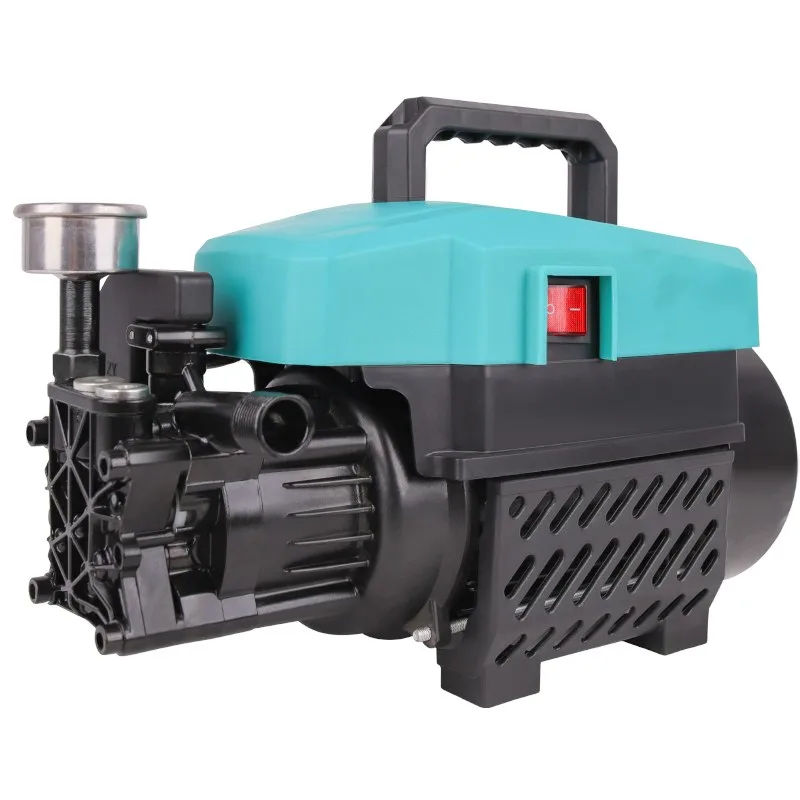
Decide by where the machine will work and what power is available there. Our portable electric models are sized for home and light commercial cleaning (cars, patios, garden furniture and shop fronts) and are carried by hand rather than wheeled. Our wheeled electric pressure washer models are built for car washes, workshops, farm yards and building maintenance, where the unit is wheeled to the job and runs off a mains supply.
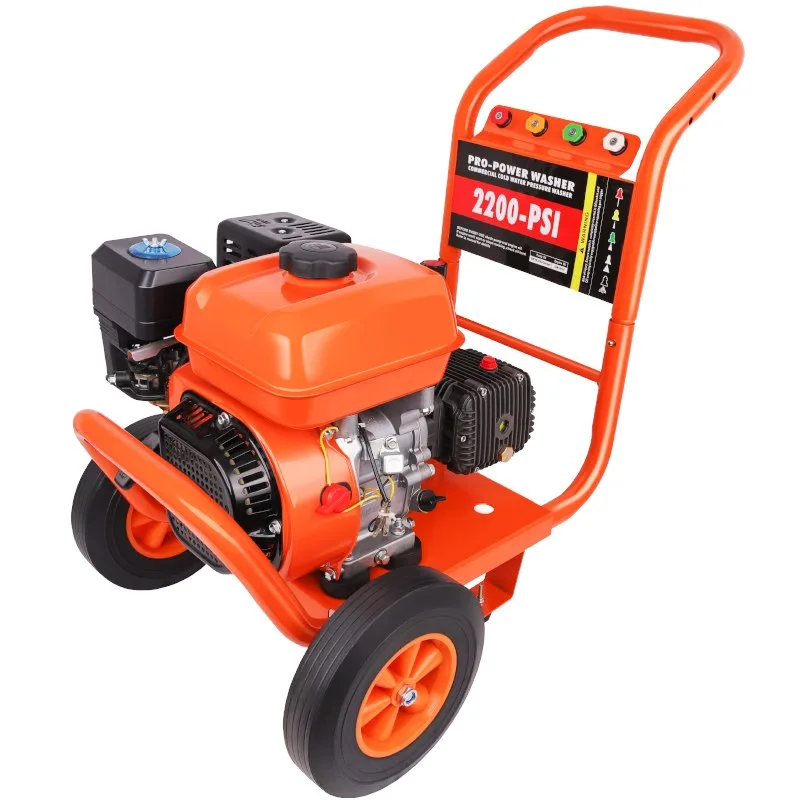
Where there is no socket, an engine takes over. Our gasoline pressure washer models go to construction sites, farms, mobile detailing and municipal cleaning, and our diesel pressure washer suits long working days and heavy duty cycles. For bulk buyers, the deciding factor is rarely the car wash machine itself but the site: the supply available, the hours of work per day, and whether the unit stays in one bay or moves between jobs.
Can a Portable Car Wash Machine Handle Home Use?
For washing a family car, a driveway and garden furniture, a portable car wash machine is the practical choice. Our six portable models run at 2,800 rpm with a 5 m spray range, an 8 m hose and inlet water up to 55-60 °C. The S4T, S6T and S8T use copper-wound motors of 550, 650 and 750 W; the S4L, S6L and S8L use aluminum-wound motors of 500, 550 and 700 W.
Because there is no engine, a portable electric unit starts instantly, needs no fuel handling and can be used indoors without ventilation concerns. Occasional cleaning is well served by a portable unit; several hours a day of continuous work calls for a cart-mounted machine with a larger pump. For distributors, voltage, plug type, hose length and decal language are set per order, and sample units can be shipped ahead of a container.
Which Car Wash Machine Suits a Wash Bay or Workshop?
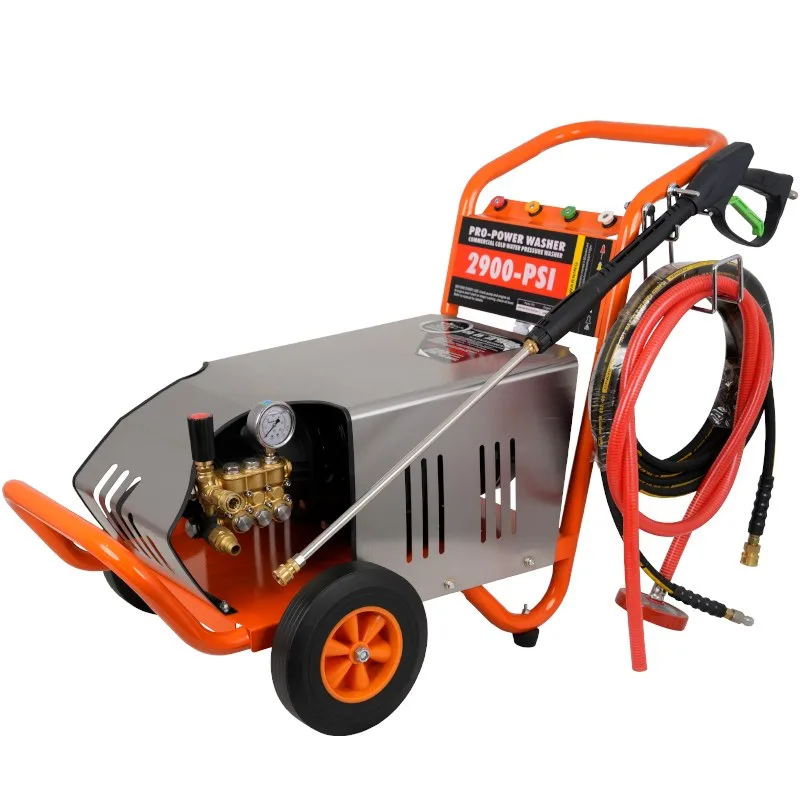
A bay that washes cars every day needs a wheeled electric car wash machine, and the building decides which one. Single-phase units connect to ordinary premises supply and suit smaller workshops, detailing bays and light commercial cleaning; three-phase units require industrial supply and are intended for heavier, longer duty. Confirm what supply the site actually has before ordering, because a machine specified for the wrong phase cannot be adapted on arrival.
| Model | Supply | Working pressure | Flow rate |
|---|---|---|---|
| 2.2 kW single-phase | 220V | 100 bar | 11 L/min |
| 3 kW single-phase | 220V | 130 bar | 12 L/min |
| 3 kW three-phase | 380V | 130 bar | 12 L/min |
| 4 kW three-phase | 380V | 150 bar | 14 L/min |
| 5.5 kW three-phase | 380V | 200 bar | 14 L/min |
| 7.5 kW three-phase | 380V | 250 bar | 14 L/min |
Every wheeled model has a copper-wound motor and ships with a 9 m hose, with 15 m or 20 m optional, with or without a hose reel. Voltage and frequency must match the destination market. If there is no suitable supply, or the customer works across scattered sites, redirect toward engine-driven equipment rather than making a mains machine fit.
How Much Pressure Does a Car Wash Machine Need?
For washing cars, 100-150 bar is the usual range; higher pressure is for other work. Car washing and general cleaning are usually served at 100-150 bar, while paint preparation, heavy plant and yard cleaning call for 200-250 bar. In our wheeled electric range, that places the 2.2 kW, 3 kW and 4 kW models (100, 130 and 150 bar) in the car wash bracket, and the 5.5 kW and 7.5 kW models (200 and 250 bar) in the heavy cleaning bracket.
Pressure releases dirt; flow carries it away and covers area. From the 2.2 kW to the 7.5 kW model, pressure rises from 100 to 250 bar, while flow rises from 11 to 14 L/min and then stops: the 4 kW, 5.5 kW and 7.5 kW models all sit at 14 L/min. So a customer who says a car wash machine is weak needs more pressure, and one who says it is slow needs more flow, which a bigger motor in this family will not give. Our article on PSI vs GPM works through the same trade in detail.
When Should a Car Wash Machine Run on Gasoline or Diesel?
Choose an engine only when the work moves or there is no mains supply. An engine removes the cable and the ceiling that a domestic socket puts on available power, which is what mobile detailing needs. Where the machine will live in one bay with power laid on, an electric unit is quieter and cheaper to run, and a gasoline car wash machine bought for a fixed bay is money spent on a feature nobody uses.
Our 168 gasoline pressure washer delivers 150 bar and 15 L/min from 5 kW, and the 188 model 250 bar and 15 L/min from 10 kW; both offer recoil or electric start. On the same 168 engine, the swash plate version gives 170 bar at 9 L/min, trading flow for pressure, so ask what the operator is removing before comparing engines. The 186FA diesel model (250 bar, 16 L/min, 7.5 kW) is for long shifts in fleet and yard cleaning, not for a detailing bay.
What Should Distributors Check Before Ordering Car Wash Machines?
Settle the specification before production: voltage, frequency and phase first, then hose length and accessory configuration, then packaging and labeling. Ask about the water supply too. A pressure washer starved of inlet water will cavitate and damage its own pump, and this causes more warranty claims than any manufacturing fault.
Plan spare parts at the same time. Seals, lances, hoses and nozzles are consumables on any car wash machine, and engine-driven units add filters and spark plugs; a distributor who stocks them keeps the customer. Where winters freeze, warn buyers that water left in a pump through a freeze will crack it. CE certification can be supported for pressure washers, and availability may vary by model and destination market. WENXIN supports OEM and ODM orders with custom logo, color, labeling and carton design. Tell us the supply on site, the daily working hours and your order volume, and our team will recommend a suitable configuration with full specifications.
Sourcing sprayers, generators or water pumps?
Talk to the WENXIN factory team about specifications, customization and OEM orders.