



How does a plunger pump work? In one sentence: a rotating shaft drives a set of plungers back and forth, each plunger draws liquid in through an inlet valve on its return stroke and pushes it out through an outlet valve on its forward stroke, and because a fixed volume moves on every stroke the pump builds whatever pressure the nozzle resists with, up to the limit the relief valve is set to. The rest of this guide takes how does a plunger pump work apart piece by piece, using our own agricultural plunger pump range as the reference, and then explains what the figures on a data sheet mean.
What Is a Plunger Pump, and Where Does It Sit in a Sprayer?
A plunger pump is the pressure-generating core of agricultural spraying equipment. Everything else on a power sprayer, engine or motor, frame, tank, hose and gun, exists to feed the pump and carry what it delivers. It is bought as a component by assemblers building sprayer units and as a replacement by dealers supporting machines already in the field, which is why anyone selling into that market hears how does a plunger pump work more often than any other technical question.
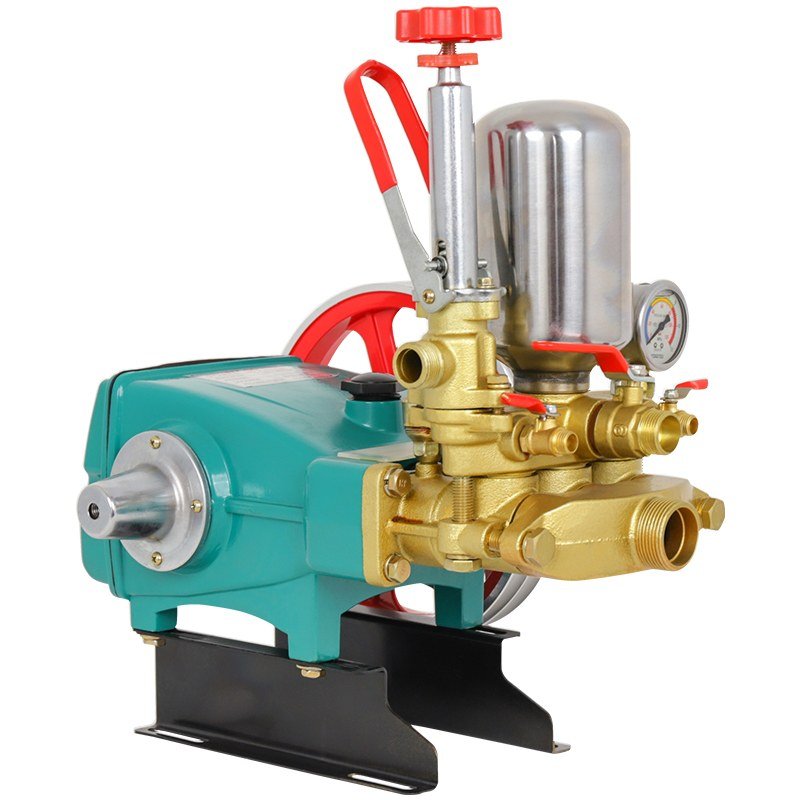
Our range covers eight cast-head models from the 16 to the 180, plus a stainless steel series in four sizes, and every one of them uses the same three-plunger layout. What changes from model to model is mainly the plunger diameter, and with it the displacement per stroke, the flow and the power needed to drive the head. Understanding how does a plunger pump work therefore means understanding one mechanism, then reading the numbers that scale it.
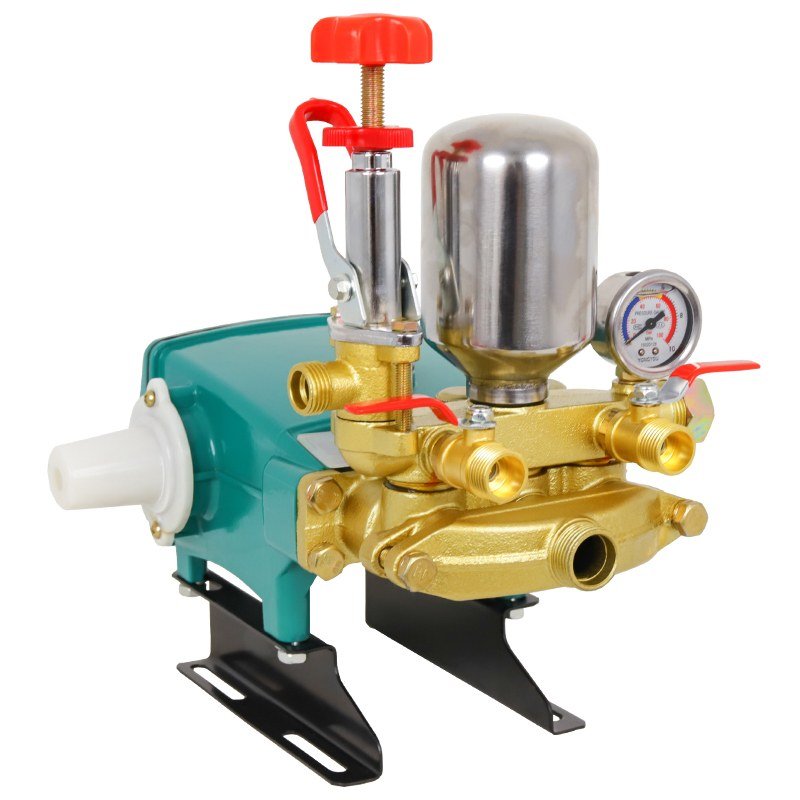
How Does a Plunger Pump Work Inside the Head?
Inside the head, the rotation of the drive shaft is converted into a short back-and-forth stroke, and each plunger runs in its own cylinder with two one-way valves. On the return stroke the plunger moves back, the space in front of it grows, the inlet valve opens and liquid is drawn in from the tank. On the forward stroke the inlet valve closes, the trapped liquid has nowhere to go but out, so the outlet valve opens and the liquid is pushed into the delivery line. That cycle, repeated on every turn of the shaft, is the short answer to how does a plunger pump work.
Three plungers rather than one matter because their strokes are staggered: while one is drawing in, another is delivering, so the line sees a nearly continuous stream instead of pulses. Seals around each plunger keep the liquid on the wet side of the head; they are the part that wears, and running above the rated working pressure shortens their life sharply. The head is cast as standard, with a stainless steel head where the liquid attacks cast metal.
Why Does a Plunger Pump Hold Pressure Where a Centrifugal Pump Cannot?
Because it is a positive displacement pump: every stroke moves a fixed volume regardless of what is downstream. A centrifugal pump throws liquid outward with an impeller, and as resistance rises its output falls away. A spray nozzle is the opposite situation: it is a restriction, and pressure has to hold behind it to break the liquid into a fine spray and carry it to the target. Unlike a centrifugal pump, a plunger pump delivers steady pressure against that resistance, which is why this pump type dominates agricultural spraying rather than water transfer; how does a plunger pump work is, at bottom, a question about pressure rather than volume.
The pump does not know when the gun is closed. The relief valve does that job: when the nozzles cannot pass what the plungers deliver, the surplus is routed back to the tank at the set pressure, adding heat and wear without adding output. That valve is the part of how does a plunger pump work that protects the pump when the trigger is released; set it to the working pressure the pump is built to hold, not above it.
What Do Plunger Diameter, Flow and Working Pressure Mean on the Data Sheet?
Three numbers describe most of what an assembler needs to know. Plunger count and diameter set the displacement; together with the speed the pump turns at, they set the flow. Working pressure is the range the pump is built to hold, not a target to be exceeded. Once you know how does a plunger pump work, the data sheet reads itself: bigger plungers move more liquid per stroke, and more liquid per stroke at the same pressure needs more power at the shaft.
| Model | Plungers | Flow rate | Working pressure | Drive power |
|---|---|---|---|---|
| 16 | 3 × 16 mm | 7–19 L/min | 20–45 kg/cm² | 0.6–1 HP |
| 22 | 3 × 22 mm | 14–22 L/min | 20–45 kg/cm² | 1.5–2 HP |
| 30 | 3 × 30 mm | 33–40 L/min | 20–45 kg/cm² | 3–5 HP |
| JPS | 3 × 28 mm | 33–44 L/min | 20–45 kg/cm² | 3–5 HP |
| 80 | 3 × 34 mm | 55–68 L/min | 20–45 kg/cm² | 5–7.5 HP |
| 120 | 3 × 38 mm | 103–116 L/min | 20–45 kg/cm² | 5–7.5 HP |
| 150 | 3 × 45 mm | 107–120 L/min | 20–35 kg/cm² | 7.5–12 HP |
| 180 | 3 × 45 mm | 107–120 L/min | 20–35 kg/cm² | 7.5–12 HP |
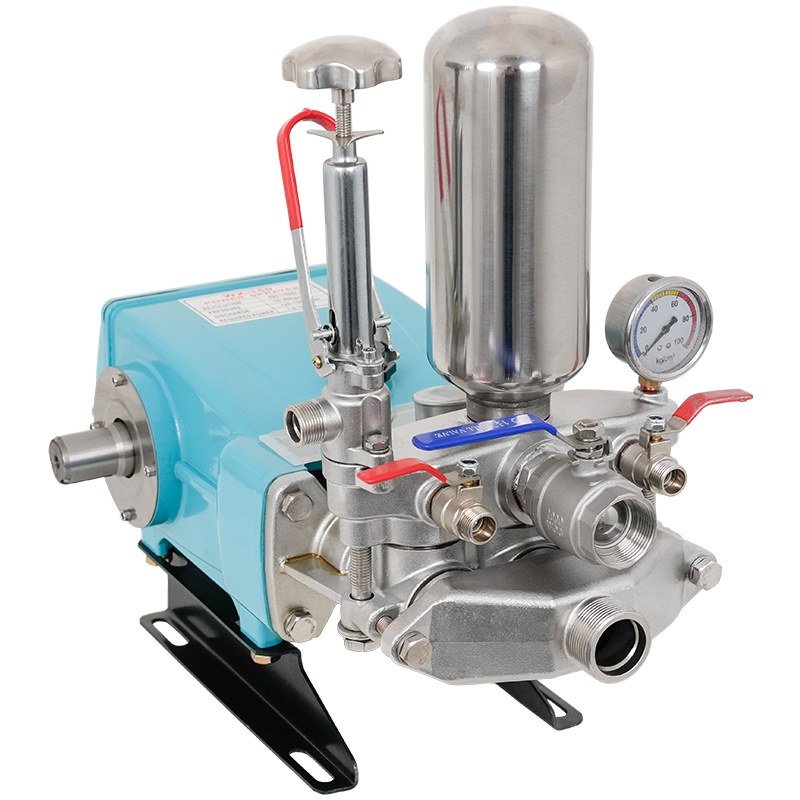
Two things stand out. From the 80 to the 120 the plunger grows only from 34 mm to 38 mm, yet the flow roughly doubles on the same power band. The two largest heads, the 150 and the 180, are rated at 20–35 kg/cm² rather than 20–45 kg/cm²: they are large-bore heads that run slower for sustained duty. The stainless steel series repeats the 22, 30, 80 and 120 sizes with the same figures: the material changes what the head survives, not how does a plunger pump work.
How Does the Drive Arrangement Change What the Pump Delivers?
The pump is one of three decisions, alongside the power unit and the frame, and the drive between engine and pump decides the speed the plungers actually run at. Direct-drive and belt-driven layouts suit different speeds and different frames, and the pump has to be selected for the speed it will actually turn at. The 22 head rated 14–22 L/min as a bare pump is listed at 22 L/min in our complete sprayer units, paired with a 6.5 hp engine; the 30 head is paired with a 7.0 hp engine and listed at 40 L/min, with the units rated for 0–4 MPa working pressure and a 0–8 m spray range. When a buyer asks how does a plunger pump work in a finished machine, the answer includes the engine: the head sets the ceiling, the drive decides how close to it the unit runs.
At the small end, how does a plunger pump work is the same question with smaller numbers. Our knapsack power sprayers carry a pump head with an 18 mm plunger, rated at 8 L/min with a 7–8 m spray range, enough to reach an orchard canopy from the ground.
What Wears in a Plunger Pump, and What Should a Distributor Stock?
Seals, plungers, valves and gaskets. A plunger pump is a serviceable component by design, and the distributor who can supply a seal kit keeps a machine in the field that would otherwise be replaced. Everything in the answer to how does a plunger pump work points at the same wear items: the seals see the full working pressure on every stroke, the valves open and close on every stroke, and grit that passes the tank strainer ends up in both.
Two habits protect them, and both follow from how does a plunger pump work. Match the pump to the nozzles the machine will carry, not to the biggest number available, because surplus flow only circulates through the relief valve as heat. Keep the pressure inside the rated range; the data sheet gives a range the pump is built to hold, not a target to beat. Where the liquid attacks a cast head, fertiliser solutions, disinfectant, and coastal or high-humidity service, specify the stainless steel plunger pump: it is the wetted parts, not the output, that the buyer is paying for.
Which Plunger Pump Should You Specify?
Specify by the flow the lances need, then check the power available to drive it; the table above and the answer to how does a plunger pump work do the rest. The 16 is the smallest pump in the range, for single-lance work and small sprayer units. The 22 is the volume seller for knapsack-scale and small trolley units, and the JPS is a mid-range head for two-lance work and mounted units. The 80 is sized for multi-lance and orchard work, the 120 is where flow roughly doubles over the 80 on the same power band, and the 150 and 180 are large-bore heads for sustained duty. Every model ships as a bare pump, or as part of a complete engine-and-frame set.
Browse the full plunger pump range, compare the 22 and the 30, see the stainless steel series, or start from a complete sprayer unit. For figures quoted in bar, MPa or psi, our guide to PSI versus GPM explains the conversions. Tell us the flow, pressure and drive arrangement you need to match, and we will confirm what fits.
Sourcing sprayers, generators or water pumps?
Talk to the WENXIN factory team about specifications, customization and OEM orders.