


Search for a mist blower and you will find the same machine our catalog lists as a mist duster: a knapsack unit that uses an engine-driven air stream to carry chemical into places a pump alone cannot reach. Search for a power sprayer and you get its pressure-driven cousin. The two look alike on a spec sheet — similar tanks, similar knapsack frames, overlapping spray distances — yet they solve different problems, and buyers who order on looks alone routinely get the wrong one. This guide separates them using the actual figures from our specification sheets, then gives you a one-line decision rule.
What Is a Mist Blower, and Why Do the Names Confuse Buyers?
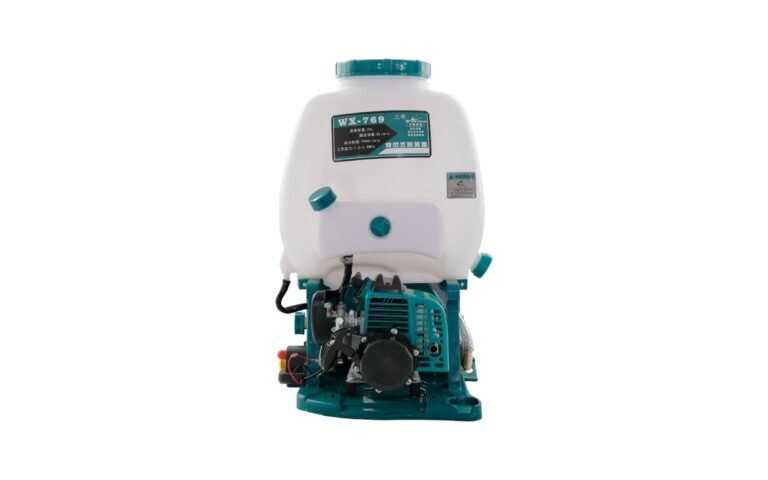
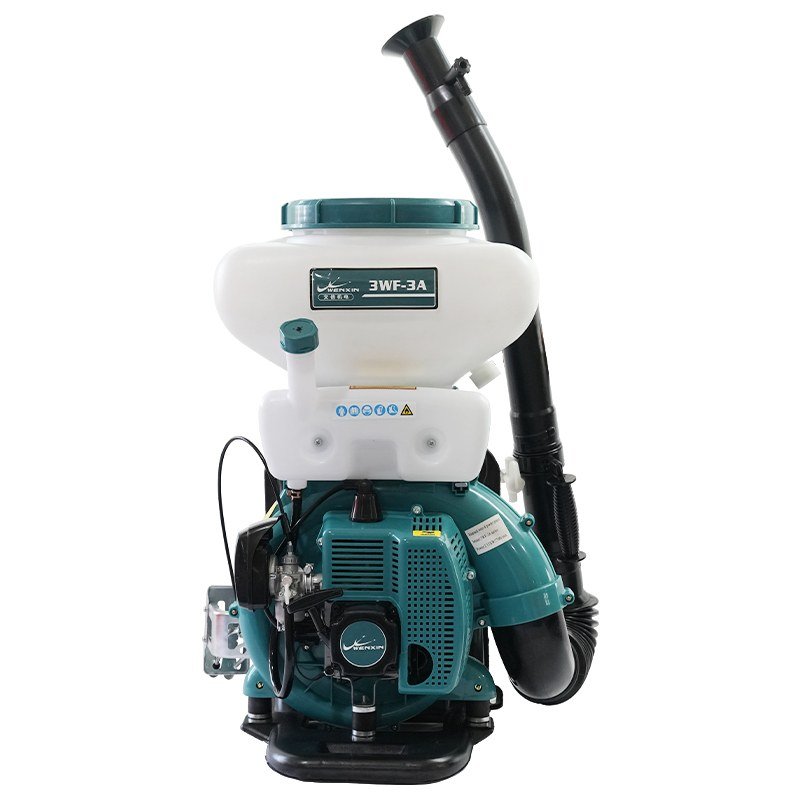
A mist blower — the same machine our catalog lists as a mist duster — atomizes liquid into fine droplets and pushes them with a high-velocity air stream from an engine-driven fan. The air does the carrying, which is why the treatment reaches into tree canopies and dense foliage instead of stopping at the outer leaves. Our mist duster range covers six models, from the 31 cc / 0.7 kW 139F platform up to the 77 cc / 3.8 kW Italian type — the widest engine spread among our knapsack machines. Five of the six are offered in the same four tank sizes, so a short model list still covers every capacity point a buyer is likely to ask for.
How Does a Power Sprayer Apply Liquid Differently?
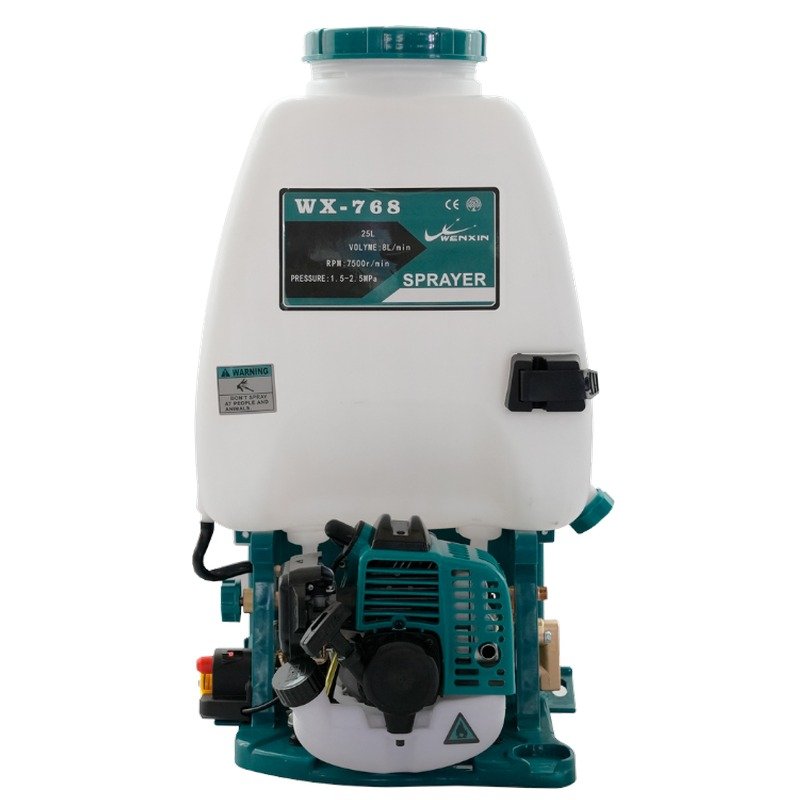
A knapsack power sprayer works on pressure, not air. Its engine drives a pump that pushes liquid out at 25–30 MPa and a flow of 8 L/min — every knapsack model in our range runs those same working figures. The result is a directed, wetting spray: you point the lance, and what you point at gets covered. Engine options stay small and light, from 25.6 to 35.8 cc and no more than 0.85 kW, because pressurizing liquid takes far less power than driving a fan.
Which One Reaches Further?
On paper the two ranges overlap: our power sprayers throw 7–8 m, while mist blower models are rated at 5–8 m or 8–10 m depending on the engine. The paper numbers hide the real difference. A sprayer’s 7–8 m is a stream of droplets that lands on the first surface it meets; a mist blower’s air column keeps droplets moving through a canopy, so the effective coverage in tall or dense crops is what sets it apart. That is why orchards, plantations and greenhouse fogging default to air-assisted machines, while row crops at waist height do not need one.
Drift is the counterweight. Air-assisted application travels further, which is exactly what makes a mist blower effective and exactly what makes wind conditions and timing matter more. Advise operators to treat in calm hours; a machine chosen for reach should not be judged by a windy afternoon.
What Engine and Tank Options Does Each Range Offer?
Mist blower buyers choose in two steps. First the reach class: the 139F and 139H (31 cc, 0.7 kW) and the four-stroke 140FP (35.8 cc, 1.0 kW) are rated 5–8 m, while the 40FP-3Z (41.5 cc, 1.83 kW), TU43 (42.7 cc, 1.25 kW) and the 77 cc Italian type are rated 8–10 m. Then the tank: 14, 20, 26 or 30 liters on the standard frames, with the Italian type carrying 18 liters. Listed weight stays between 11.5 and 12 kg across the range. Power sprayer tanks run 15 to 30 liters, all customizable for OEM orders.
Note what changes with tank size and what does not. On a given model the engine and blower set the reach, and the reach stays the same whether the tank holds 14 or 30 liters — a larger tank buys fewer refill stops, not more distance. So establish the height you need to treat first; once the reach class covers it, pick capacity purely by how far the operator walks between refills and how much weight they will carry.
Can a Mist Blower Apply Powder as Well as Liquid?
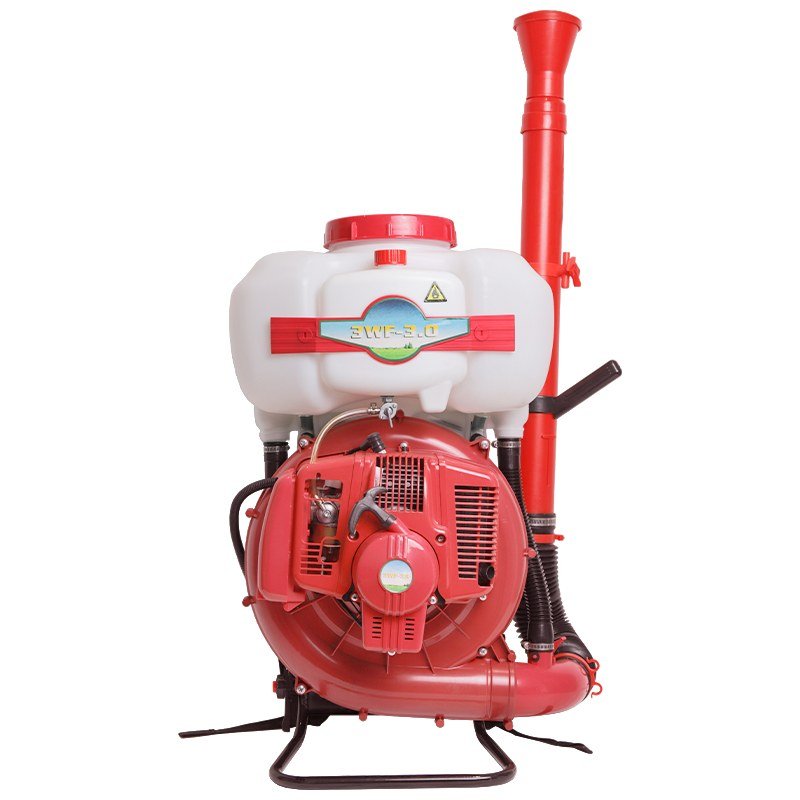
Yes — the “duster” half of the name is literal. The same air stream that carries mist can deliver powder, which is why one mist blower can cover both wet spraying and dry dusting seasons. A power sprayer is a liquid machine: its plunger pump, hose and lance are built around fluid under pressure. If your buyers treat crops with both liquid chemical and powder formulations, that dual role is the single strongest argument for the air-assisted machine — but confirm what will be applied, since powder and liquid place different demands on accessories.
Mist Blower or Power Sprayer: Which Should You Choose?
Use the height rule — and remember a mist blower carries the consumables of two systems, an engine and a spray line, so stock nozzles, filters, hoses and engine service parts alongside the machines. If the treatment target sits above head height or inside a canopy — orchards, plantations, tall greenhouse crops, warehouse disinfection — choose the mist blower. If the target is at or below waist height in open rows, the power sprayer is the lighter, simpler, cheaper tool, and its 25–30 MPa pressure gives precise, thorough wetting. Distributors serving mixed farming regions usually stock both, in roughly the proportion of tall crops to row crops in their market. Browse the full agriculture sprayer line, compare models like the 40-3 mist duster and the 768 knapsack power sprayer side by side, or tell us your crop profile and we will point you at the right configuration.
Sourcing sprayers, generators or water pumps?
Talk to the WENXIN factory team about specifications, customization and OEM orders.