



A battery sprayer for agriculture replaces the hand lever of a manual knapsack sprayer with a rechargeable battery and a small electric pump, so the operator sprays without pumping and the pressure does not fade between strokes. For an importer the real question is where a battery sprayer for agriculture stops and an engine-driven machine takes over. This guide compares our electric knapsack sprayers with our gasoline (petrol) knapsack power sprayers, using the figures printed in our catalog, so that a distributor can decide which one to stock or how to split an order between the two.
- Battery sprayer for agriculture (full-size electric knapsack models): 16, 18, 20 and 25 L PP tanks, all rated 3–6 L/min at 0.3–0.6 MPa with a 3–5 m spray distance.
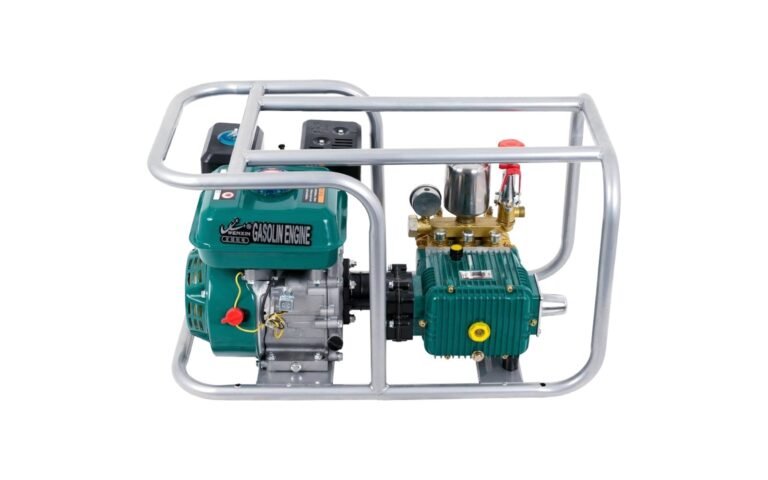
- Knapsack power sprayer: 15, 20, 25 or 30 L tank, small gasoline engine, 18 mm plunger pump, 8 L/min and a 7–8 m spray range.
- Where each fits: battery where the operator walks the plot; gasoline where throw and output matter, such as orchard and tall-crop coverage.
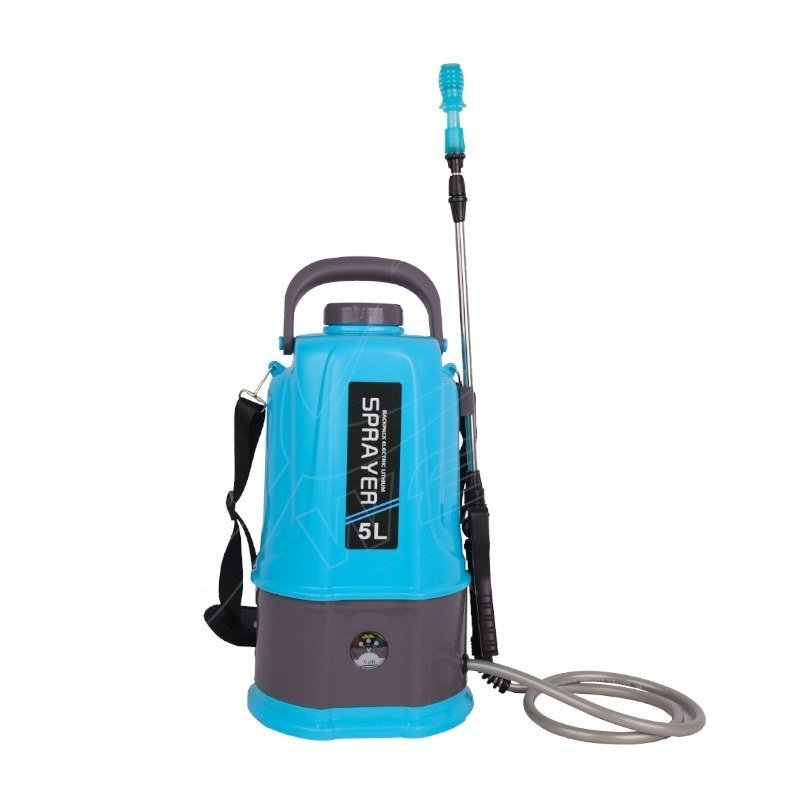
- Small lithium units: 2 L and 3 L hand-held sprayers for greenhouses and small plots, and the 5 L, 8 L and 10 L side-mounted Type 2 for garden, greenhouse and light field work.
What Is a Battery Sprayer for Agriculture and How Does It Work?
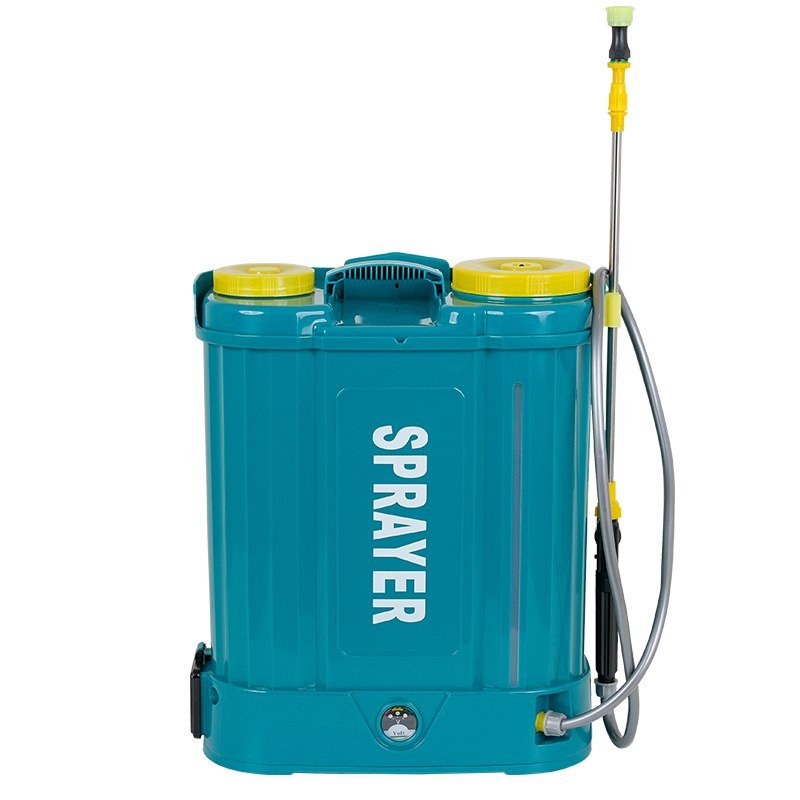
A battery sprayer for agriculture is a knapsack sprayer whose pump is driven by a battery instead of a hand lever or an engine. It keeps the tank, hose, lance and straps of the manual sprayer, but replaces the hand lever with a battery and a small water pump in the base. The structure diagram in our own manual for the electric backpack line names the parts in this order: large cap, water filter, barrel body, inlet filter, base, power switch, charging socket, voltage meter, battery, water pump, bottom cover, water hose, switch water handle, spray rod, shower nozzle and charger. The assembly drawing in that manual adds the back cushion and straps, and labels the pump as a diaphragm pump.
In use, the operator fills the tank, switches the pump on and opens the handle. In general, because the pump keeps running, the spray does not rise and fade with every stroke as it does on a manual sprayer, and nobody has to pump while walking the rows. Our knapsack sprayer diagram guide names these parts one by one.
How Much Can a Battery Sprayer for Agriculture Spray per Minute?
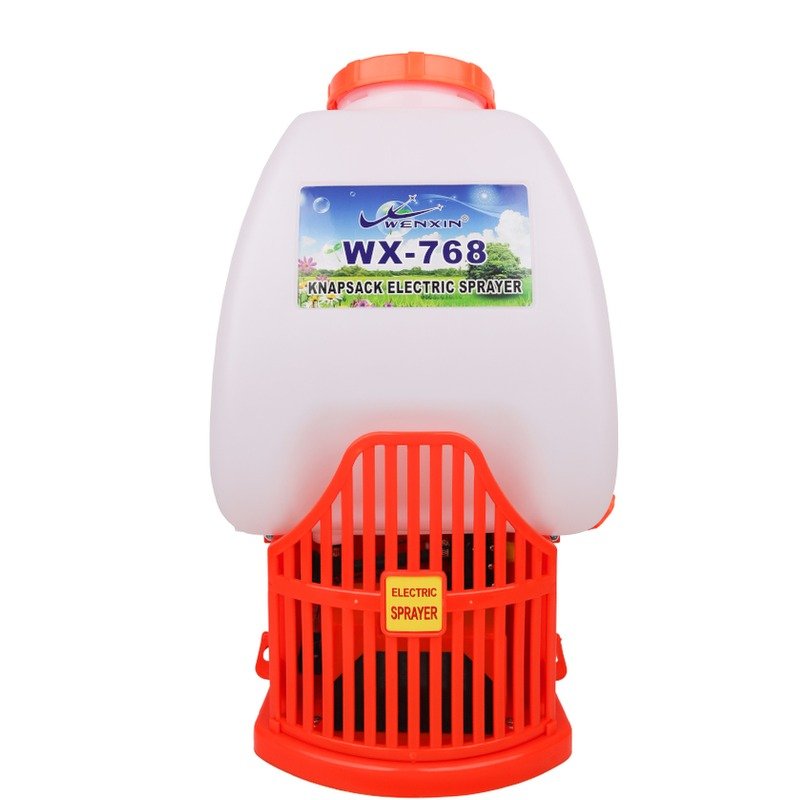
From 16 L to 25 L the answer is the same: 3–6 L/min at 0.3–0.6 MPa with a 3–5 m spray distance. That holds for the stripe type in 16 L, 18 L and 20 L, the bull head in 16 L and 20 L, the 18 L octagonal and the 25 L 768 electric sprayer, all with PP tanks. Choosing a tank size is therefore a question of refill frequency against carried weight, not of output. The 25 L model is aimed at operators covering more ground between refills, which matters most where water is not close to the plot.
Below that class sit the lithium units, which are not a full-size battery sprayer for agriculture but cover the small jobs around it:
- Side-mounted lithium Type 2: 5 L, 8 L and 10 L PP tanks, 1–3 L/min at 0.2–0.5 MPa, 3–5 m spray distance.
- 2 L and 3 L lithium: hand-held, 0.3–0.5 L/min at 0.1–0.15 MPa, 1–2 m, made for greenhouses and small plots.
What Battery and Charger Does a Battery Sprayer for Agriculture Use?
Our manual for the 16 L–18 L electric backpack line gives the battery as 12 V / 8 Ah, fully enclosed and maintenance free. The supplied charger is rated for an input of AC 100–240 V at 50/60 Hz and an output of DC 12 V 2 A. It is described as a three-section charger (constant current, constant voltage, maintenance) with short-circuit, over-current and inverse-connection protection; its lamp shows red while charging and green when charged or on stand-by. The battery charges through the charging socket without being removed from the sprayer, and the manual asks for at least 8 hours per charge.
It also describes an under-voltage alert: in prolonged operation an alarm sounds when the battery voltage falls to 10.5 V, so as to protect the battery. The manual is written for the line as a whole and does not list model numbers, so treat 12 V / 8 Ah as the line’s reference figure and have the battery, the charger and the running time per charge confirmed for the exact battery sprayer for agriculture on your quotation.
How Does a Gasoline (Petrol) Knapsack Power Sprayer Compare?
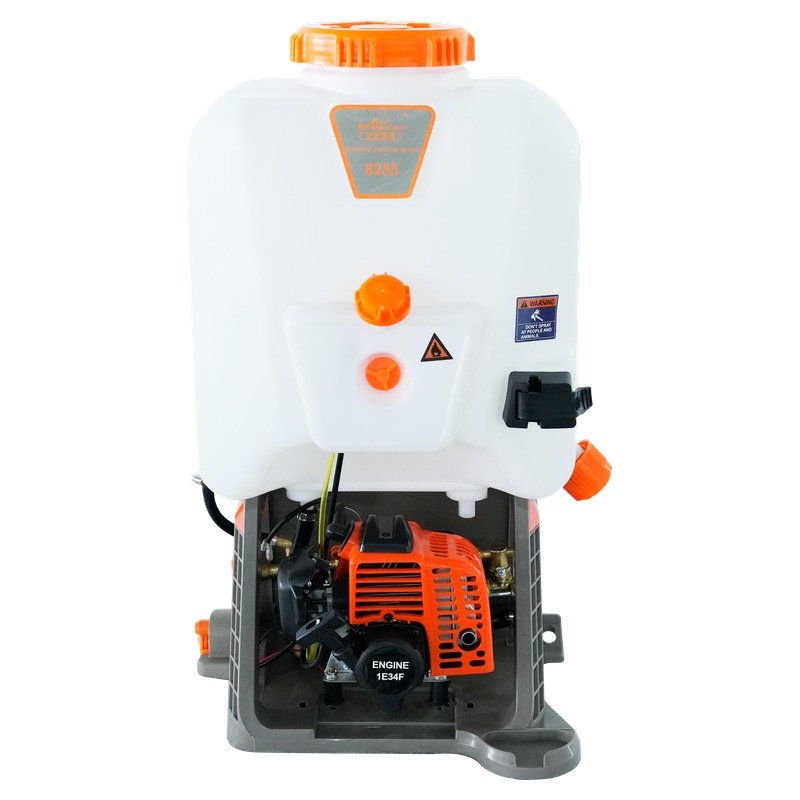
A knapsack power sprayer puts a small gasoline engine and a plunger pump under the tank. On our range the tank holds 15, 20, 25 or 30 L depending on the model, all customizable. The pump is an aluminum pump head with an 18 mm plunger, working at 25–30 MPa and rated at 8 L/min with a 7–8 m spray range, the same across the line. Four engine options from 25.6 to 35.8 cc and 0.7 to 0.85 kW cover two-stroke and four-stroke preferences, and a 90 cm brass spray gun is standard. Side by side with a battery sprayer for agriculture, the catalog figures read as follows:
| Catalog figure | Battery sprayer for agriculture | Knapsack power sprayer |
|---|---|---|
| Drive | Battery and electric water pump | Gasoline engine and plunger pump |
| Tank | 16, 18, 20 or 25 L, PP | 15, 20, 25 or 30 L, customizable |
| Flow rate | 3–6 L/min | 8 L/min |
| Working pressure | 0.3–0.6 MPa | 25–30 MPa |
| Spray distance | 3–5 m | 7–8 m |
How the plunger pump builds that pressure is explained in how does a plunger pump work.
Which Crops and Plots Suit Each Type of Sprayer?
A battery sprayer for agriculture suits work where the operator walks the plot. Our product pages place the 16 L, 18 L and 20 L stripe type in row crops, orchards and greenhouse work, the side-mounted lithium Type 2 in garden, greenhouse and light field work, and the 2 L and 3 L hand-held units in greenhouses and small plots. With a 3–5 m spray distance and 3–6 L/min, the full-size electric models handle that row-crop, orchard and greenhouse work without anyone working a lever.
Where more throw is needed, the knapsack power sprayer takes over: its 7–8 m of throw is built for orchard and tall-crop coverage. The two machines are complements rather than substitutes, which is why the same distributor can list both: the electric sprayer range for growers who walk their plots, and the knapsack power sprayer range for growers who need reach. For mist and powder application, see our comparison of a mist blower vs power sprayer.
What Are the Differences in Running and Maintenance?
In general, a battery sprayer for agriculture has no engine to start, no fuel to carry and no exhaust behind the operator, and its pump runs more quietly than a small engine. In exchange it has to be recharged, so the working day is planned around the battery. A gasoline machine refuels in the field and keeps working as long as there is fuel, but it brings engine care: clean fuel, the right oil mix on a two-stroke, an air filter and a spark plug.
The troubleshooting table in our electric sprayer manual points to a short list when spraying weakens: a clogged or worn spraying sheet, a clogged filter screen, loose tube clamps at the pump, air left in the pump, or a battery short of power. On a knapsack power sprayer, check the plunger and its seals, the valves, the nozzle, the gaskets and the strainer first. Both types want the same habit at the end of the day: flush the tank, hose and lance with clean water (see how to use a knapsack sprayer).
What Should Importers Check Before Ordering?
When a battery sprayer for agriculture goes on a purchase order, five points are worth settling in writing:
- Tank mix: the 16 L, 18 L and 20 L stripe type share one platform and one output, so the split between them follows what your growers are used to carrying.
- Battery and charger: ask for the battery and charger specification of the exact model on your quotation, and name the plug type your market uses.
- Carton: confirm what ships in the box and the packed size; the 25 L 768 electric sprayer, for example, packs at 38 × 21 × 64 cm, one piece per carton.
- Branding: custom logo, color, labeling and carton design are supported on both the electric and the gasoline ranges.
- Engine choice on power sprayers: on models such as the 767, four engine options let one model number run across markets with different two-stroke and four-stroke habits.
Send the target market and the estimated quantity with the inquiry, and the quotation can cover pricing and lead times for both types at once.
What Do Buyers Ask About a Battery Sprayer for Agriculture?
Does a bigger tank spray harder? No. From 16 L to 25 L, every electric knapsack model in our range is rated 3–6 L/min at 0.3–0.6 MPa with a 3–5 m spray distance. A bigger tank means fewer refills and more carried weight, not more output.
Is a battery sprayer for agriculture enough for orchards? Our product pages list orchards among the uses of the 16 L, 18 L and 20 L stripe type, which sprays 3–5 m. Where orchard and tall-crop coverage needs more throw, the 7–8 m range of a knapsack power sprayer is the answer.
Which one should a new distributor stock first? Start from how your growers work. Plots that the operator walks favor the battery sprayer for agriculture; orchard and tall-crop coverage favors the gasoline machine. A distributor can list both: the flow, pressure and spray-distance figures above do not overlap.
To compare models of battery sprayer for agriculture with our gasoline range, or to request a quotation for either, contact our team with your target market and estimated quantity.
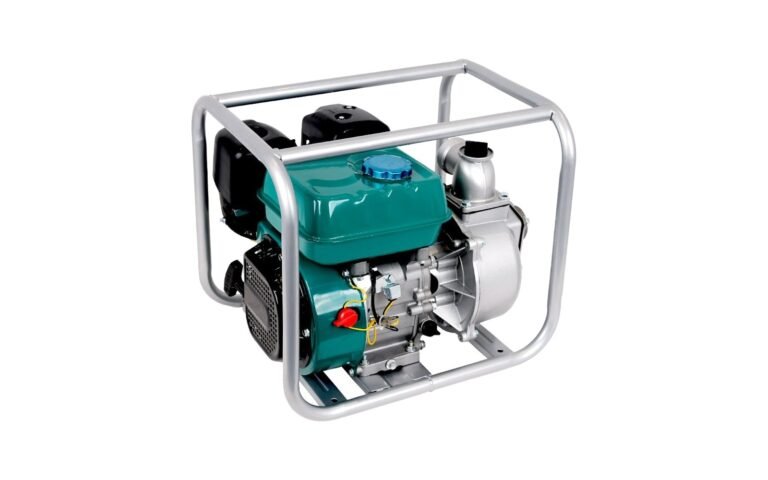
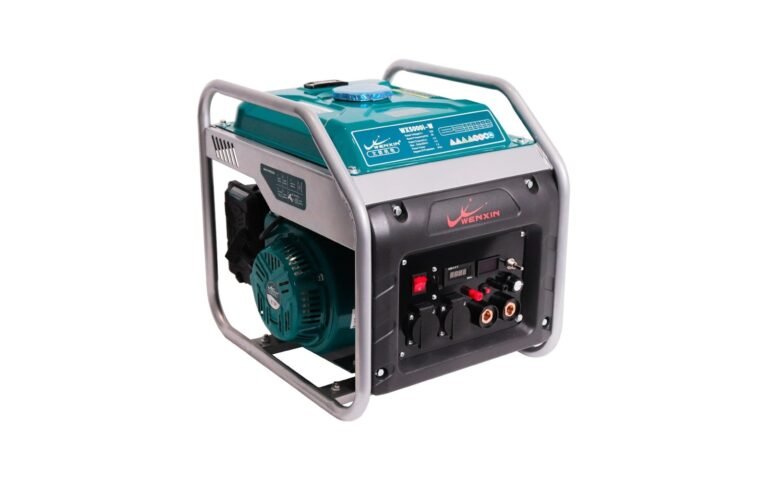
Sourcing sprayers, generators or water pumps?
Talk to the WENXIN factory team about specifications, customization and OEM orders.